Country Guide
SOMALILAND – At a Glance:
- Population = 3.5 Million
- Urban Population = 1.6 Million
- Capital City = Hargeisa
- Area = 137,600 km2
- Coastal Length = 850 Km
- Currency = Somaliland Shillings (SlSh)
- Standard Time Zone = GMT+3
- Religion = Sunni Islam
- Languages = Somali, Arabic and English
HISTORY
The union did not work according to the aspirations of the people, and the strain led to a civil war from 1980s onwards and eventually to the collapse of the Somali Republic. After the collapse of the Somali Republic, the people of Somaliland held a congress in Burco on May 18th 1991 in which it was decided to withdraw from the Union with Somalia and to reinstate Somaliland’s sovereignty.
GEOGRAPHY
TOPOGRAPHY
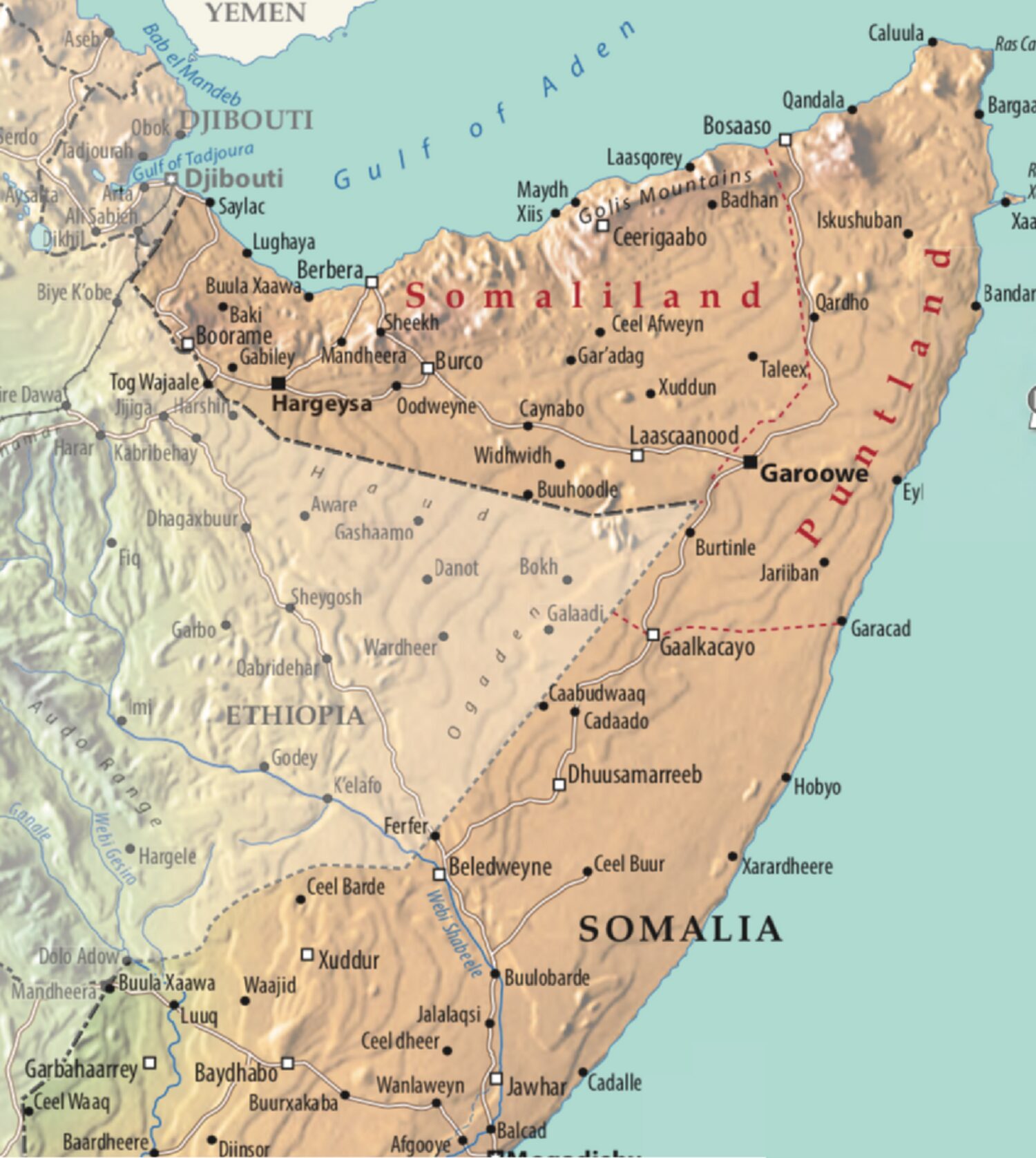
The major topography features are:
- The low-lying coastal plains known as the Guban, running some 70 km inland with a very hot summer climate. A high escarpment running east-west parallel to the coast and rising to over 2000m at Erigavo.
- A plateau to the south of the mountains known as Ogo, extending to Ethiopia, with an average altitude of 1200m. Further inland and to the south is the Haud, red sandy plains stretching southwards into Ethiopia, where altitudes fall to some 500m.
CAPITAL CITY & MAIN TOWNS
POLITICAL SYSTEM
The country has a republican form of government. The legislative assembly is composed of two chambers – an elected elder’s chamber, and a house of representatives. An elected President and an elected Vice-president head the government. The President nominates the cabinet which is approved by the legislature. There is an independent judiciary
The country has three political parties. i.e Waddani Party, Kulmiye Party and UCID party. The current President of the Republic is H.E Muse Abdi Bihi and the vice-president is H.E Abdurrahman Abdillahi Ismail of Kulmiye who were elected on December 2017 for a five-year term.
ECONOMY
The official Somaliland currency is the Somaliland shilling (SlSh). It is regulated by the Central Bank of Somaliland which was constitutionally established in 1994.
The most important sector in Somaliland is livestock production which is predominately pastoral and agro-pastoral in Somaliland employing over 70% of the population. Livestock is the major export of Somaliland accompanied by its by-products i.e. hides and skins while the country heavily depends on imports of food, fuel and manufactured products. Livestock production in Somaliland contributes to 60% of GDP and around 85% to foreign export earnings (Somaliland National Development Plan, 2012 – 2016). Somaliland’s agricultural sector accounts for around 17% of the economy making it the second most important sector.
Somaliland’s economy is also heavily dependent on remittances sent by the global Diaspora which equates to around $1 billion per annum.