1.1 General background and introduction to the Telecoms industry in Somaliland
Prior to Somaliland’s re-independence in 1991, the telecoms sector was heavily monopolized by the central government led by the corrupt regime of Siad Barre. Since the overthrow of his regime, Somaliland has developed a modern and telecommunications industry with widespread mobile usage among the populace. Regarding Somaliland’s telecoms sector, it has substantial coverage with strong telecommunication services reported in all regions. A privately owned dominated ICT sector is seen as one of the key contributing factors for telecommunications access in regional Somaliland.
Under the late dictator’s Socialist regime prior to 1991, the telecommunications sector in Somaliland had always been in the public domain, without there being a single private sector service provider. However, the solitary state-owned telecommunications provider itself disintegrated with the collapse of the central government in 1991. The ensuing civil strife and political chaos at the time led to the destruction of the Public Switch Transmission Network and other key telecommunication infrastructure throughout then then Somali Republic. Hence, for a number of years the Somaliland’s telecommunications network was, by and large, disconnected from the rest of the world. Therefore, Somalilanders were generally without the means to connect to the large expatriate community of friends and relatives outside the country and vice versa. Nevertheless, for business savvy Somali entrepreneurs this void presented an amazing opportunity rather than a dilemma. By exploiting the gap in this now unregulated market various privately-owned companies emerged, competing to provide missing infrastructure and telecommunications services both local and international. In 1993 alone, nine telecommunication companies emerged. With the privatization of these companies came competition, allowing for an expansion of mobile services, lower costs, greater efficiency, an overall decrease in prices, and technological advancement in the sector.
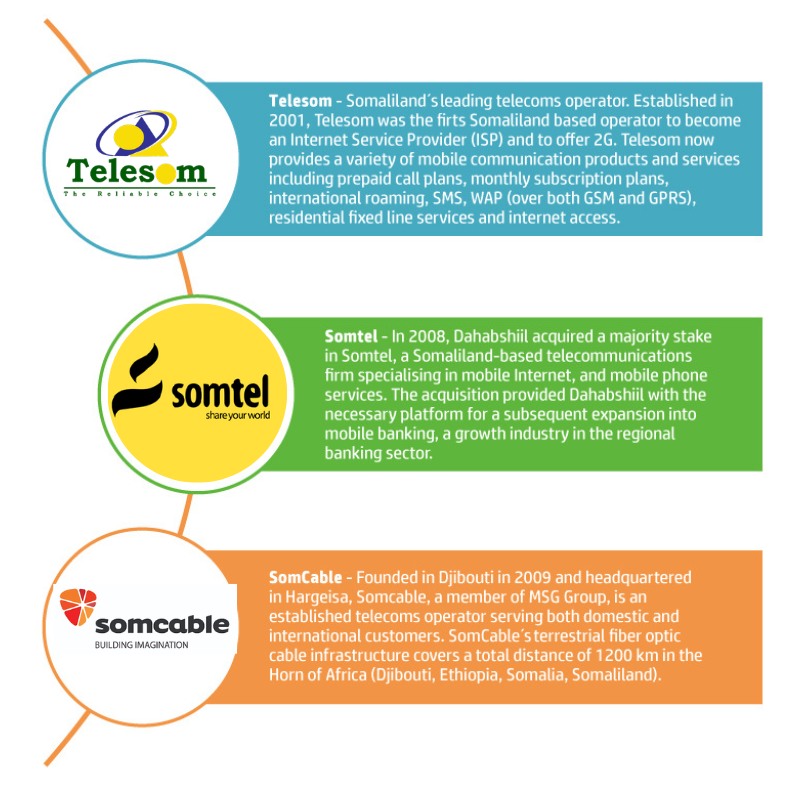
Observers of Somaliland’s telecoms sector are in agreement that the economic policies of the late President Mohamed Ibrahim Egal (which included a light touch regulatory approach to telecoms) strongly boosted the sector and Somaliland’s economy. Indeed, during President Egal’s demilitarization campaign, he chose to borrow substantial, multi-million-dollar loans from business tycoons to fund the early stages of state-building in Somaliland. A key contingent of these Somaliland based business tycoons were from the telecoms industry both in Somaliland and nearby Djibouti. Since the President Egal era, Somaliland’s telecommunications sector has grown substantially and has been facilitated by the simplicity of the infrastructure required and quick returns on investment. Together with the remittance sector, the telecommunications sector has become the leading private sector industry within Somaliland. External analysts have long referred to Somaliland’s telecommunications systems as among the best and most innovative in Africa. Somaliland’s main telecom players Telesom, Somtel and Somcable even offer competitive data and voice services. Somaliland can lay claim to one of the most technologically advanced and competitively priced telecommunications and internet services in the world. Somaliland’s telecoms sector has been funded by entrepreneurs and backed by expertise from China, Korea and Europe, these nascent telecommunications firms offer affordable mobile phone and internet services that are not available in many other parts of the continent.
1.2 History of Telecoms sector in Somaliland
The rapid development of the telecoms sector in Somaliland took place in the mid-1990s during Somaliland’s early state-building years. As such these major telecommunication service providers competed in a deregulated market with the absence of: taxes, regulatory laws and the collapse of foreign exchange controls as well as the lack of license providers. Since then these major telecom operators moved quickly to take advantage of the lack of restrictions and regulation made possible by the lack of a functioning regulatory law overseeing the telecoms sector.
A key characteristic of this period is that Somaliland’s private sector led on the growth of the telecoms sector compared to the government as in most African states. Telecom operators instead pooled their own resources to build the required infrastructure such as communication towers and radio masts for fixed voice and internet services. Following on from this, during the early 2000s these same telecom operators took the lead in installing cell towers throughout the country to create Somaliland’s current cellular network. The raised structure cell towers typically support antennae and one or more sets of transmitter/receivers’ transceivers, digital signal processors, control electronics and a GPS receiver for timing. In Global System for Mobile Communications (GSM) networks, the correct term is Base Transceiver Station (BTS), and colloquial synonyms are “mobile phone mast” or “base station”. The term “base station site” might better reflect the increasing co-location of multiple mobile operators, and therefore multiple base stations, at a single site. Depending on an operator’s technology, even a site hosting just a single mobile operator may house multiple base stations, each to serve a different air interface technology (CDMA2000 or GSM, for example). Such an environment also allowed equipment to be brought in cheaply and set up quickly. In short, the lack of red tape, government interference and regulation freed Somaliland’s telecoms operators to become innovative and fast moving compared to their African peers who were mostly owned by major foreign operators such as Orange and Indian based Bharti Airtel. This has enabled Somaliland’s main telecom operators to count themselves as among the most sophisticated in Africa. Somaliland’s telecoms consumers are able to make the cheapest local and international calling rates in the world. Customers can conduct money transfers and other banking activities via mobile phones, as well as easily gain wireless access. In Somaliland, the local availability of telephone lines (tele-density) is higher than in neighboring countries; which is three times greater than in adjacent Ethiopia. In short, without the leadership of the private sector in Somaliland’s telecoms sector, fixed line and mobile penetration would not be as high as they presently are.
1.3 The widespread usage of telecoms and mobile communications among Somaliland’s population