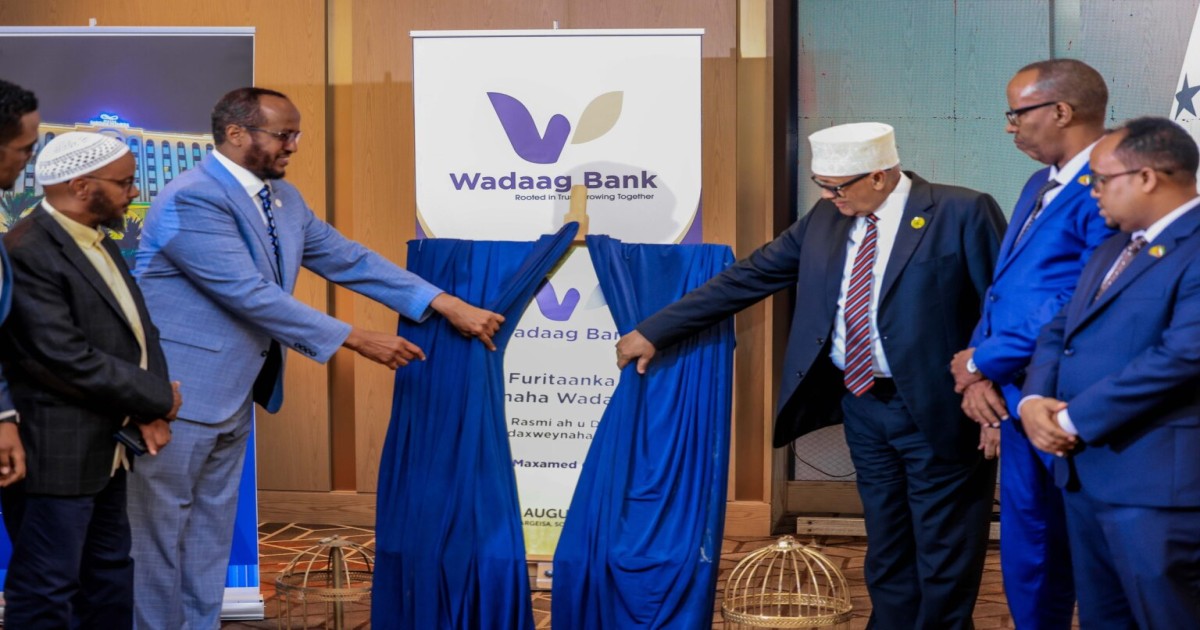
Somaliland’s banking sector has a new entrant. On Sunday 31 August 2025, Somaliland President Abdirahman Mohamed Abdillahi (Cirro) inaugurated Wadaag Bank at a ceremony in Hargeisa — formally launching a new Shariah-compliant commercial lender that its founders say will expand access to financial services, support local production and attract investment into the economy.
The Launch
The inauguration drew a notably broad audience. The ceremony was attended by senior government officials, leaders of the national political parties, business executives, representatives of established banks, academics, members of the diaspora and civil society groups. The Deputy Governor of the Central Bank, the Chairman of the Private Banks Association, the Chairman of the Somaliland Chamber of Commerce, the chairmen of the Kaah and Waddani parties, and the Ministers of Trade and of Investment Promotion and Industry all spoke or attended.
President Cirro used his address to frame the launch in national economic terms. He congratulated the bank’s founders and shareholders for their investment, and argued that modern financial institutions are central to economic development, job creation and attracting both domestic and foreign capital. “Banks are the backbone of the national economy,” he said, according to our reporters from the event. “They drive markets, encourage investment and create opportunities for young people.”
The President also positioned the launch as a marker of broader economic confidence – describing a strengthening banking sector as a reflection of Somaliland’s resilience and its commitment to economic transformation.
What Wadaag Bank is
Wadaag Bank describes itself as a fully digital, Shariah-compliant institution. The name itself — wadaag, meaning “to share” in Somali — signals the bank’s positioning as a “people’s bank” built on pooled community resources.
The bank’s stated objectives centre on three ideas: unifying the financial strength of the Somaliland people, stimulating local production and national self-reliance, and reducing poverty through wider financial inclusion. Its chairman, Abdirashid Baaxeer, used the launch to invite broad public participation in the bank’s shareholding. “We welcome everyone living in the country, the diaspora, businesspeople and youth to buy shares in the people’s bank, Wadaag Bank,” he said.
On the product side, the bank is positioning itself around digital banking from the outset. Its services span personal and business loans, savings and fixed-deposit schemes, microfinance, insurance, and sector-specific financing across livestock, fishing, agriculture, health, education and real estate. One detail stands out as distinctly local: Wadaag says it intends to formalise and digitise the hagbad – the traditional Somali rotating savings system — bringing an informal practice that millions already use into a regulated, digital framework. The bank also operates a “Diaspora Digital Gateway” aimed at letting Somalilanders abroad send or invest funds directly into Wadaag accounts.
Wadaag Bank operates from the Wadaag Bank Tower in Hargeisa, opposite the Barsame Business Centre.
The Wider Context
Wadaag enters a banking sector that has expanded considerably over the past decade. Somaliland’s formal financial system is overseen by the Bank of Somaliland, the central bank, which maintains an official registry of licensed institutions. That registry already includes established names such as Dahabshiil Bank International, Darasalaam Bank and Premier Bank, alongside others – a diverse list that did not meaningfully exist a generation ago.
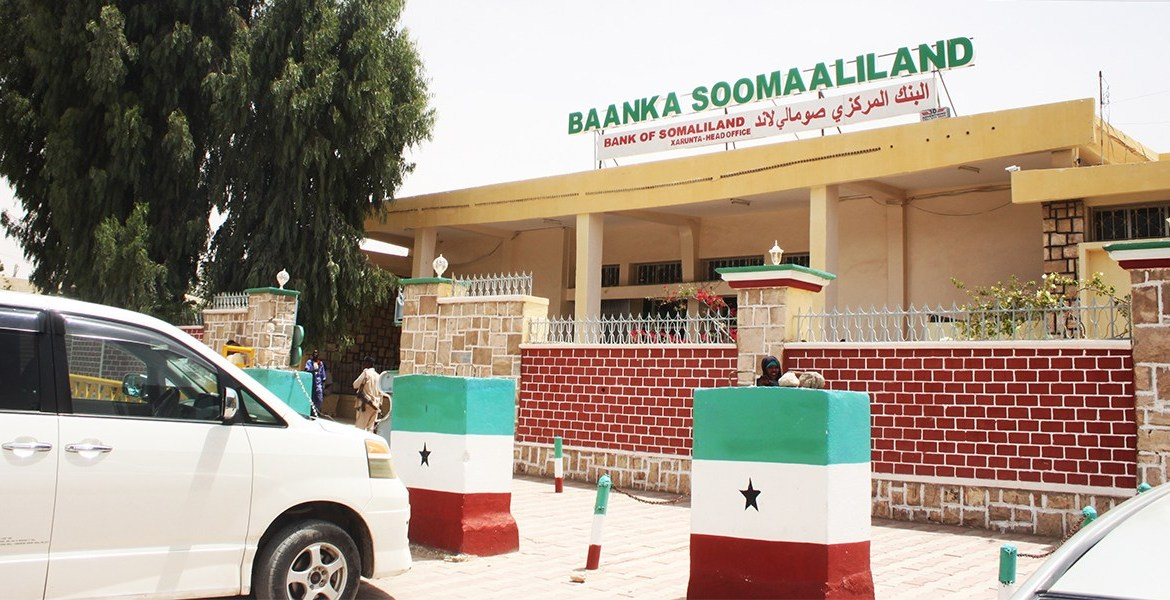
For most of Somaliland’s modern history, formal banking was thin. Remittance companies and money-transfer operators filled the gap left by the absence of international banks, moving diaspora money home and serving as the de facto financial rails of the economy. The steady licensing of commercial banks – and the government’s parallel push to strengthen regulation and align local practice with international standards – represents a deliberate shift towards a more formalised, more investable financial system. The arrival of Wadaag Bank is part of that trajectory.
Our View
A new bank opening is, on its own, a business story. What makes Wadaag Bank’s launch worth more than a passing mention is what it represents in aggregate.
Each newly licensed, regulated bank in Somaliland does two things at once. It widens the range of formal financial services available to businesses and households – and, just as importantly, it deepens the institutional credibility of the financial sector as a whole. Investors, both diaspora and foreign, read a growing roster of regulated banks as a signal: that the rules are firming up, that capital can be deployed and recovered through formal channels, and that the economy is maturing beyond cash and informal remittance flows.
Wadaag’s specific positioning is slightly unique with their offering of shares to the public from the outset; the premise is to promote a sense of collective ownership, a bit like mutually owned banks or building societies in some western markets. The share cost, taken from their website, states “One share cost $1,100 | $1,000 goes to share value and $100 is the admin processing fee. 1 share is the minimums number of shares to purchase”. We won’t go into analysing this as a standalone investment opportunity as the focus of this post is on simply informing our readers about the launch of the actual bank.
The questions that matter now are the ones that always follow a launch. How quickly can Wadaag build deposits and a functioning loan book? How robust is the regulatory and capital framework underpinning it? And can a “people’s bank” funded partly through public share offerings maintain the governance standards that long-term trust requires? Those answers will come with time.
For now, the direction of travel is clear. Somaliland is building out a formal banking sector, bank by bank — and Wadaag Bank is the newest sign that the project is gathering pace.
Sources: Wadaag Bank (wadaagbank.com); Horndiplomat; Somaliland National TV; Bank of Somaliland licensed-institutions registry. Details of the inauguration are drawn from contemporaneous reporting of the 31 August 2025 ceremony.